 By Charles
My living room coffee table has three jobs. Breakfast on weekdays, laptop stand from 9 to 5, and a board game arena on Saturday nights. For two years, it failed at all three. The surface was too low for typing, too cluttered for cereal, and the “storage basket” underneath had become a graveyard of HDMI cables, takeout menus, and one mystery sock.
Then I started testing lift top coffee tables. Not because I was bored — because my chiropractor told me to stop hunching. Six months and four units later, I have opinions. Some of them will save you $600 and a sore neck.
If you’re in a small apartment, working from your couch, or just tired of looking at piles of stuff on your coffee table, this guide is for you. If you have a dedicated office and a separate dining room, you can probably skip ahead — you don’t need this much furniture-in-one.
What a Lift Top Coffee Table Actually Solves
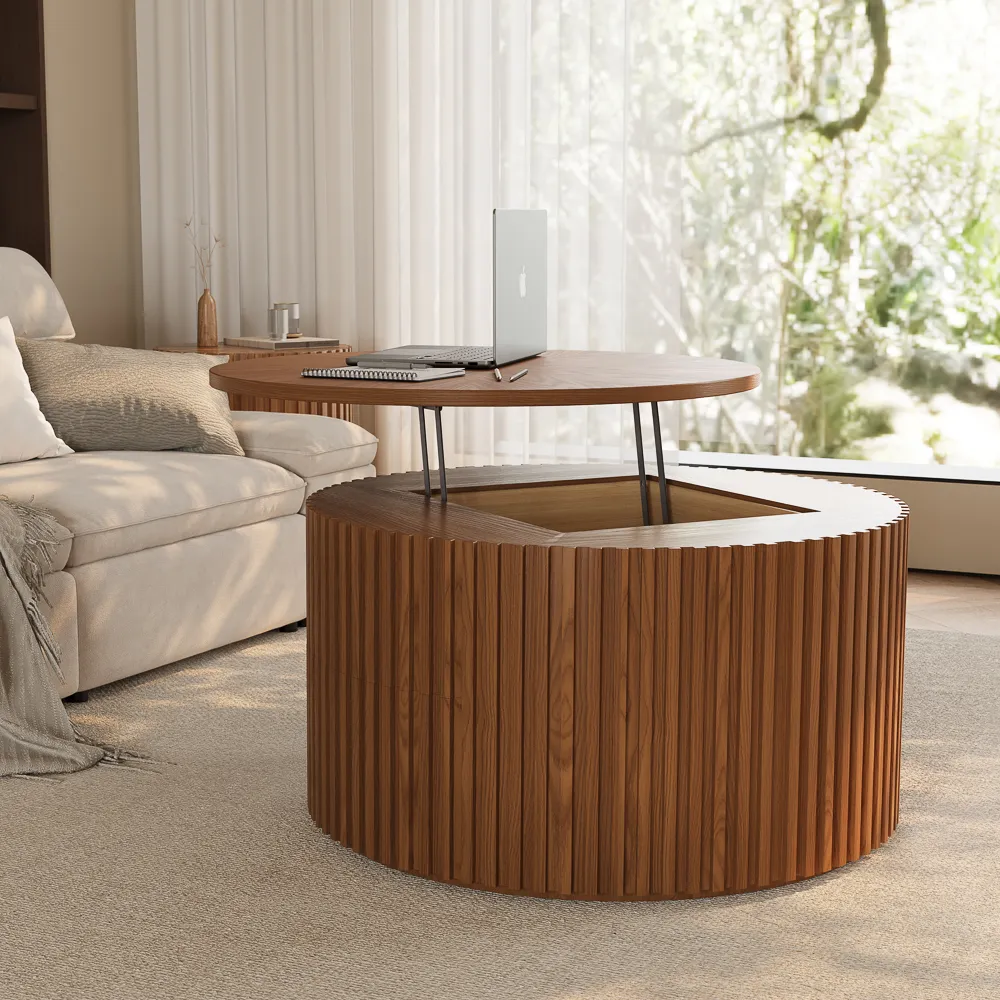
A lift top coffee table with storage is a regular coffee table where the top panel rises on a hinged mechanism — usually 6 to 12 inches — and slides forward toward the sofa. Underneath the top is a hidden compartment. That’s the whole product.
What it solves is more interesting than what it is. Three things, specifically:
- The laptop-on-couch problem. A standard coffee table sits 16 to 18 inches off the floor. Dimensions lists 10–18 inches as the standard coffee table height range. Your laptop screen ends up below your sternum and you crane forward. A lifted top hits roughly 26 to 30 inches — close to a desk.
- The visible-clutter problem. Remotes, chargers, kids’ art supplies, half-read magazines. They have nowhere natural to live in most living rooms. The hidden compartment is genuinely useful, not decorative.
- The we-don’t-have-room-for-a-desk problem. If your apartment is under 700 square feet and your “office” is the couch, this single piece replaces a desk you literally cannot fit.
Here’s what it doesn’t solve: posture for 8-hour workdays. I’ll come back to that.
Best Rooms and Routines for Lift Top Storage
Not every living room needs one of these. Let me get specific about who actually benefits.
Small Apartments
If your living room is under 200 square feet, a lift top earns its keep. My sister’s Brooklyn one-bedroom is 14′ × 11′ in the living area. She tried adding a small desk against the wall, and it ate three feet of walking path between her couch and kitchen. The desk lasted four months before she sold it on Facebook Marketplace.
She replaced it with a lift top that’s 40″ wide × 22″ deep. Two things mattered:
- The footprint stayed identical to her old coffee table. Zero square footage lost.
- The internal storage replaced an entire bookshelf. She measured: 8″ deep × 36″ wide × 18″ front-to-back = roughly 5 cubic feet of hidden space. That’s a lot of laptop bags, blankets, and chargers.
Before you buy, do the tape test. Lay painter’s tape on the floor where the coffee table will sit. Then add another tape line showing where the top will slide forward toward your sofa — usually 8 to 12 inches of forward travel. If that forward position blocks your walking path or hits the couch cushions, the table is too big for the room.
Standard guidance: leave 14 to 18 inches between the coffee table edge and the front of your sofa so people can walk through. A lifted top eats some of that gap. Measure first.
Work-From-Home Living Rooms
This is where the lift top earns or loses its money. Here’s my honest test:
I tracked five workdays where I used my lift top as a laptop desk. Two facts:
- For meetings, email, and Slack, the height was fine. The raised top landed at 28 inches. My laptop screen sat at eye level when I leaned slightly forward on the couch. No neck pain after a 90-minute video call.
- For 6+ hour coding or writing sessions, it failed. Couches don’t have lumbar support. By hour 4, my lower back hurt. By hour 6, I’d given up and moved to the kitchen counter.

The lift top is a hybrid solution. It’s a transition zone between “I’m relaxing with a laptop” and “I need a real desk.” If you take 2–4 video calls a day, eat lunch on the couch, and do most deep work at a co-working space or kitchen table, it’s perfect. If you’re a full-remote engineer doing 8 hours of focused work on the couch, please buy an actual desk and a chair. Your spine will thank you.
One more workday detail: the lift mechanism lets me switch in about 4 seconds. Lunch at noon (top down), 1pm meeting (top up, laptop placed), 2pm break (top down, plate of snacks). That speed is the entire point. A regular coffee table can’t do this without a separate lap desk.
Lift Top vs Drawer Storage
Both hide stuff. They solve different problems.
| Feature | Lift Top | Drawer Storage |
| Storage shape | One large open compartment | Multiple shallow compartments |
| Best for | Laptops, blankets, board games, large items | Remotes, coasters, small items, organized categories |
| Access | Lift entire top | Pull drawer toward you |
| Doubles as workspace | Yes (raised surface) | No |
| Hardware complexity | Gas springs or friction hinges | Drawer slides |
| Typical lift weight capacity | 30–50 lbs on top panel | N/A |
| Average price range | $250–$650 | $200–$550 |
Pick lift top if: You need workspace flexibility, store large items (blankets, laptop bags), or want one piece doing two jobs.
Pick drawer storage if: You want organized small-item storage, never plan to type on it, or you have kids who’d fight you over an upward-swinging panel.
I own both styles in different rooms. The lift top lives in the WFH living room. The drawer table lives in the guest TV room where nobody needs to work.

Stability, Cleaning, and Kid-Safety Trade-Offs
This is where most online reviews get vague. Let me get specific.
Stability. The mechanism matters more than the wood. There are two common hardware types:
- Gas-spring lifts (also called pneumatic). Smooth, slow, supports weight evenly. Better quality but adds cost. My favorite for daily use.
- Friction hinges (sometimes called “manual lift”). Cheaper, more common in budget units. Can develop wobble after 6–12 months of use because the metal tension wears down.
When the top is lifted, side-to-side wobble is the failure mode to test. Press down firmly on one corner of the lifted top. A well-built unit moves less than half an inch. A poorly built one rocks like a seesaw and your laptop slides.
Ask the seller two specific questions:
- What is the weight capacity of the lifted top panel? 30 lbs minimum for a laptop + coffee + book. 50 lbs is comfortable.
- What is the lift mechanism type? If they can’t answer, walk away.
Cleaning. The hinge gap collects crumbs. I clean mine weekly with a soft brush along the seam where the top meets the base. The interior compartment needs a wipe-down every couple of months because dust falls in every time the top rises. Avoid leaving sticky drinks anywhere near the hinge — a Coke spill into the mechanism will glue it shut.
Kid safety. This is the part nobody talks about clearly. The CPSC’s tip-over guidance focuses on tall furniture, but lift tops have their own specific risks: pinched fingers in the hinge, and a heavy top dropping if the gas spring fails.
If you have kids under 5:
- Choose gas-spring mechanisms — they descend slowly even if released suddenly. Friction hinges can slam down.
- Look for finger-pinch guards on the hinge gap. Better units include them; cheaper ones don’t.
- Confirm the interior compartment doesn’t have small magnets or loose hardware a toddler could pry out. POVISON tables meet CARB Phase 2 emissions standards, which limits formaldehyde release for indoor air quality — relevant if your kid uses the lowered top as a coloring desk.
My nephew (age 4) has used mine for two months without incident. The gas spring was the deciding factor.
What to Check Before Buying Online
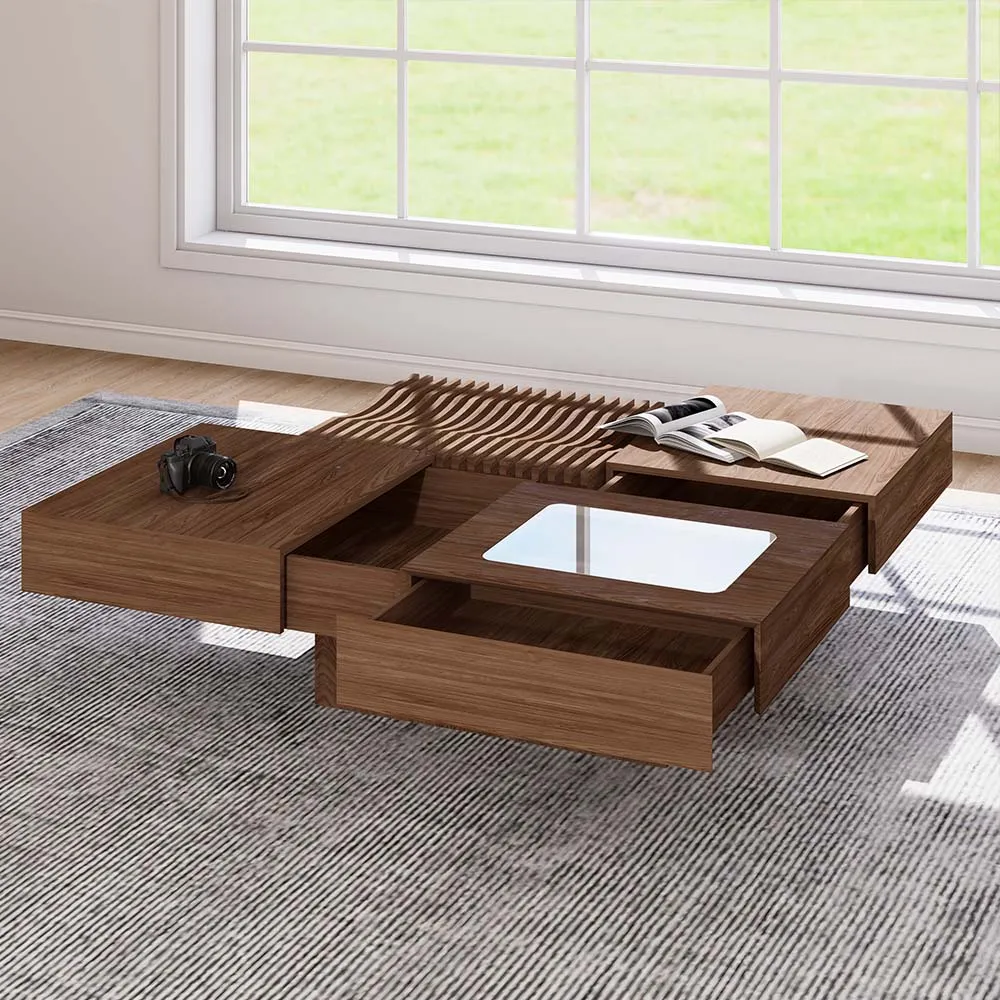
Lift tops are one of the harder furniture categories to buy sight-unseen. Here’s my pre-purchase checklist. If you can’t get a clear answer on each, don’t order.
- Lift mechanism type — Gas spring preferred. Manual friction hinges are acceptable for budget builds but ask about replacement parts.
- Top panel weight capacity — Aim for 30–50 lbs minimum.
- Total table weight — Most lift tops weigh 55 to 75 lbs assembled. Heavier = more stable, but also harder to move.
- Material grade — Solid wood top is rare in this category. Most use veneer over MDF or particle board. That’s fine if the core is CARB Phase 2 certified. Avoid uncertified imports.
- Assembly requirement — Lift mechanisms are the single most assembly-error-prone furniture component. A misaligned gas spring will fail within weeks. POVISON ships lift top coffee tables fully assembled — the mechanism arrives pre-calibrated by the factory. For context, the average flat-pack lift top requires 75–110 minutes of assembly, and a survey of Amazon reviews suggests roughly 1 in 6 buyers report mechanism issues traced to setup error. Pre-assembled removes that failure mode entirely.
- Delivery method — A 65-pound box up three flights of stairs alone is not a plan. White-glove delivery brings the unit into your living room and places it. POVISON includes this option, with damage-in-transit coverage.
- Return policy — 30 days minimum. The wobble issue isn’t always obvious until week 2 of use.
If you’re comparing options, the POVISON coffee table collection lists mechanism specs, weight capacity, and CARB certification on each product page — the data you actually need is in one place, not buried in FAQs.

FAQ
Is a lift top coffee table with storage actually worth it for small spaces and WFH?
A lift top coffee table is worth it for small spaces and WFH setups if your living room serves more than one purpose daily — laptop work, meals, social use. The hidden compartment replaces a small storage piece, and the raised top removes the need for a separate desk in apartments under 700 square feet. It’s not worth it if you have a dedicated office or you do 8+ hours of focused work daily; buy a real desk instead.
Do lift top coffee tables wobble or feel unstable when lifted?
Lift top coffee tables can wobble, but it depends entirely on the mechanism. Gas-spring lifts are stable and support 30–50 lbs on the raised top with minimal sway. Cheap friction hinges develop wobble within 6–12 months as the metal tension wears. Test by pressing on one corner of the raised top — movement under half an inch is acceptable.
How much real storage can you fit inside a lift top coffee table?
Most lift top coffee tables offer 3 to 6 cubic feet of interior storage. A typical 40″ × 22″ unit fits a 15-inch laptop, two folded throw blankets, a small board game stack, and a tangle of charging cables — with room to spare. Larger 48″-wide units approach 7 cubic feet, enough to hide an entire seasonal swap of small decor.
Are lift top coffee tables easy to clean and safe around kids?
Lift top coffee tables are easy to clean if you wipe the hinge seam weekly with a soft brush and dust the interior every two months. For kid safety, choose gas-spring mechanisms (slow descent), look for finger-pinch guards, and confirm the unit meets CARB Phase 2 emissions standards if children will sit close to it daily. Avoid friction-hinge models in homes with toddlers — the top can slam down if released suddenly.
Conclusion
A lift top coffee table with storage is a specific solution to a specific problem: your living room is doing too many jobs and you can’t add another piece of furniture. If that’s your situation, the right one — gas-spring mechanism, CARB-certified materials, 30+ lb top capacity, pre-assembled — replaces a desk and a storage cabinet in one footprint.
If your apartment is roomy, your work happens at a real desk, and your living room is just for relaxing, saving money. A simple drawer-storage coffee table costs less and has fewer parts to fail.
Before you order anything, do the tape test. Mark out the table’s footprint and its forward-slide position. Sit on the couch. Pretend to type at the raised height. If it feels right in tape form, it’ll feel right in wood.
When you’re ready to compare specs and certifications side-by-side, the POVISON Ready To Live In coffee table collection lists every detail I checked for in this guide — mechanism type, weight capacity, CARB compliance, and white-glove delivery options. Everything arrives fully assembled, so the lift mechanism works on day one instead of day thirty.
Related Reading:


