 By Charles
I have a distinct memory from 2018: standing in my guest room, sweating profusely, wrestling with a rusty manual pull-out couch while my in-laws waited in the driveway. The metal frame was stuck, the mattress was flimsy, and I swore right then that my next furniture purchase wouldn’t require a wrestling match. If you are tired of the “bar-in-the-back” sleep experience or the sheer physical exertion required to convert traditional sleepers, you might be eyeing an upgrade. Here is what I discovered after testing the electric sofa bed pros and cons to see if the motorized convenience is actually worth the price tag.
The Verdict: Buy or Pass?
Bottom Line: An electric sofa bed is a definitive BUY if you frequently host guests or suffer from back pain, but a PASS if you move apartments often or are on a strict budget under $800.
- Best For:
- Busy Parents: Convert the room from “play zone” to “guest suite” in under 30 seconds with a baby on your hip.
- Elderly Relatives: Zero physical strength required to operate.
- Multi-Use Spaces: Home offices that need to become bedrooms instantly without moving heavy furniture.
- Skip If:
- You Move Frequently: These units are 30-50 lbs heavier than manual versions due to the motor.
- Budget < $800: Reliable electric mechanisms start at a higher price point; cheap ones burn out.
- Key Specs to Look For:
- Cycle Time: Should open/close in <20 seconds.
- Motor Warranty: Minimum 3 years (accept nothing less).
- Weight Capacity: Look for 500+ lbs support.
- Price Reality: Expect to pay a $200-$400 premium over manual equivalents.
What Is an Electric Sofa Bed and Why Busy Families Choose It?
When I first started researching, I had to ask myself: Do I really need a motor in my couch, or am I just being lazy? After digging into the mechanics, I realized it’s not about laziness; it’s about longevity and utility. An electric sofa bed utilizes a linear actuator motor system—similar to what you find in high-end medical beds or luxury recliners—to extend and retract the mattress frame smoothly. Unlike the ‘yank and pray’ method of traditional sleepers, this relies on consistent, mechanical force, which is why I consider it an investment in longevity, not just laziness.
How the Motorized Mechanism Simplifies Daily Use for Parents
The primary appeal isn’t just the cool factor; it is the reduction of friction in your daily routine. If you have ever tried to unfold a sofa bed while a toddler is screaming or a dog is underfoot, you know the struggle. The motorized mechanism usually operates via a remote or a discreet button panel.
Why this matters for the “Smart Homeowner”:
- Safety: No snapping hinges or heavy metal bars dropping on fingers (or paws).
- Consistency: The motor moves along a track, meaning less wear and tear on the fabric from uneven pulling.
- Speed: We are talking about a transition time of roughly 15-25 seconds versus the 2-minute ordeal of removing cushions, lifting frames, and unfolding legs.
Electric vs Manual: Real-World Price & Value Comparison
Before you drop the cash, it is crucial to understand what you are actually paying for. An electric sofa bed typically costs 20% to 50% more than a manual counterpart, but it extends the furniture’s usable lifespan by reducing physical strain on the frame.
Here is a breakdown of how the three main types of convertible sofas compare in a real-world setting:
| Feature | Electric Sofa Bed | Manual Pull-Out (Traditional) | Click-Clack / Futon |
| Average Price | $1,200 – $3,500 | $800 – $2,000 | $300 – $800 |
| Setup Time | 15-30 Seconds (Push Button) | 2-5 Minutes (Manual Labor) | 1-2 Minutes (Awkward Folding) |
| Physical Effort | Zero (Finger press) | High (Lifting 40+ lbs) | Medium (Pushing backrest) |
| Mattress Quality | High (Often memory foam) | Low (Springs/Thin foam) | Low (Just the cushion) |
| Durability | 10+ Years (if motor is quality) | 5-7 Years (Frame often bends) | 3-5 Years (Mechanism wears) |
| Best Use Case | Daily sleeping / Frequent hosting | Occasional guest use | College dorms / Playrooms |
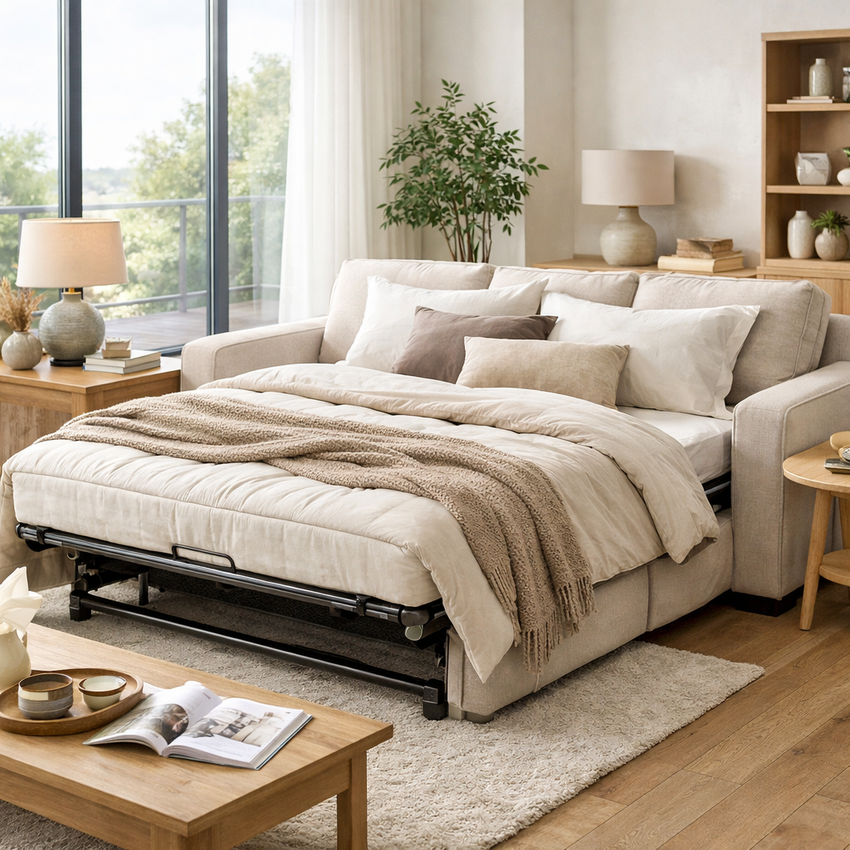
How Long Does Setup Actually Take? (The Unboxing)
I ordered a mid-range electric model to replace the “guest room torture device.” I tracked the process to give you a realistic idea of the labor involved.
The Delivery:
First warning: These things are heavy. My unit arrived in two large boxes. The base unit weighed significantly more than a standard sofa because of the steel mechanism and motor.
- Box 1 (Frame/Motor): 145 lbs
- Box 2 (Arms/Cushions): 40 lbs
The Assembly:
I prepared for a battle, but the “smart” part of this furniture is that the complex engineering is already done at the factory.
- Unboxing: 5 minutes (lots of protective foam).
- Assembly: 15 minutes. It mostly involved sliding the armrests into pre-mounted brackets and connecting one power cable.
- The “Aha” Moment: I plugged it into the wall, pressed the button, and watched it unfurl. It hummed quietly—less than 50 decibels, about the volume of a refrigerator—and locked into place.
Total Time: 20 minutes from box to nap-ready. Compared to the 2 hours I spent assembling a manual IKEA sleeper years ago, this was a massive win for my Saturday afternoon.
5 Time-Saving Benefits Electric Sofa Beds Offer Homeowners
After living with this electric sofa bed for six months—and subjecting it to two kids, a Golden Retriever, and three sets of grandparents—I’ve moved past the “honeymoon phase” and found the practical benefits.
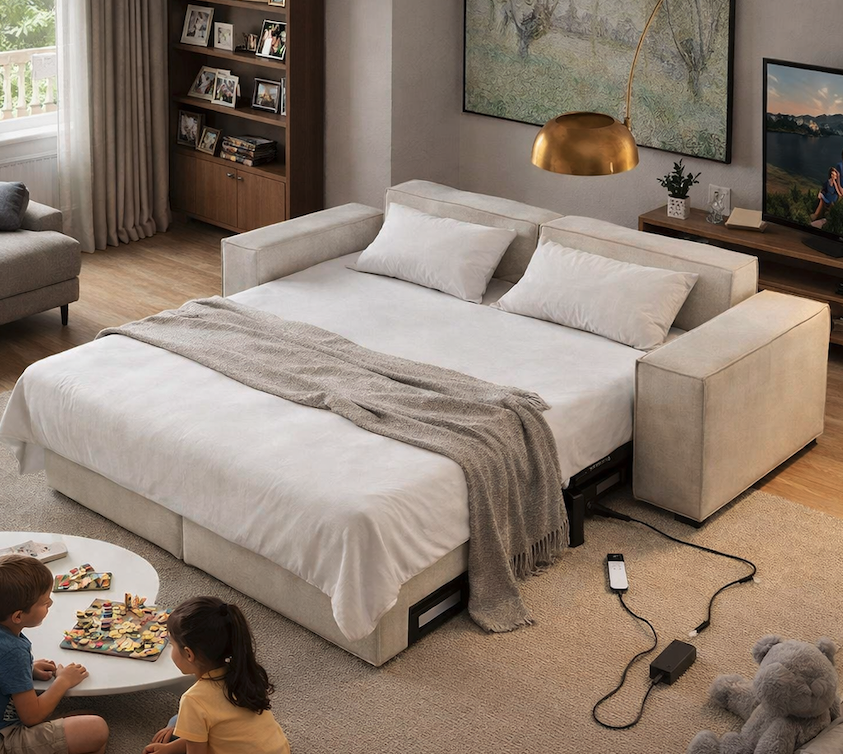
1. One-Touch Operation: Reclaim 10 Minutes Daily
It sounds trivial, but saving 10 minutes matters when you are rushing to get ready for work while a guest is waking up. You don’t need to strip the bed, fold it, and wrestle cushions every morning. You hit “close,” and while the bed retracts, you are free to make coffee. Over a week-long visit from in-laws, that is over an hour of time saved.
2. Zero Physical Strain for Parents with Active Kids
If you have ever thrown your back out trying to lift a stuck sleeper frame, you know this pain. The electric motor does 100% of the lifting. For parents who are already constantly lifting toddlers (25-35 lbs), eliminating this extra physical burden is a legitimate health benefit.
3. Adjustable Positions for Family Movie Nights
Unlike manual beds that are either “up” or “down,” many electric models offer intermediate positions. We use a “lounge” setting where the bed is extended halfway—perfect for family movie nights where everyone wants to put their legs up, but we don’t want to fully convert the room into a bedroom.
4. Modern Design That Complements Pet-Proof Decor
Because electric mechanisms require a sturdy base, these sofas tend to sit closer to the ground and lack the flimsy legs of older models. This solid base prevents dog toys from rolling underneath (a small but mighty victory). Design experts at Architectural Digest have tested and reviewed various sleeper sofa options, confirming that modern electric models offer superior construction quality.
In fact, you don’t have to sacrifice style for function. If you are into the trending ‘Pinterest Aesthetic,’ take a look at this 116.1″ Electric Sofa in Cream Style. It combines that classic French Retro look with the modern motor—perfect if you want your living room to be ‘Instagram-ready’ but still nap-friendly.
5. Electric vs Manual: Which Fits Your Pet-Friendly Home?
In a manual setup, the exposed metal springs are a hazard for pets who like to crawl under furniture.
The electric mechanism is usually encased, significantly reducing the risk of a curious cat getting pinched.
Charles’ Pick for Pet Owners: If your home is as chaotic as mine (kids + dogs), you need fabric that forgives accidents. I highly recommend checking out this Modular Sleeper Sofa with Water-Proof Fabric. It’s the only one I found that survives muddy paws and juice spills while still looking like a designer piece.
4 Drawbacks to Weigh Before Investing in an Electric Model
I value honesty over hype. As much as I love the convenience, there are trade-offs you need to know before you swipe your card.
1. 20-50% Price Premium: Is It Worth $200-500 Extra?
You are paying for the motor, the wiring, and the sturdier frame. If you only have guests stay over once a year, the ROI (Return on Investment) is low. This investment makes sense only if the bed is used monthly or if you intend to keep the piece for 10+ years.
2. Power Dependency: What Happens During Outages?
This is an important point to plan for. Most POVISON electric sofa beds are designed for plug-in use, so the powered function needs access to a wall outlet. If the power goes out while the sofa bed is moving, it may remain in its current position until electricity returns.
- The Fix: Place the sofa bed near a reliable wall outlet and keep the cord path clear behind the sofa or along the wall, not across a walkway. Before buying, check the product detail page or confirm with customer service for the exact power requirements, setup instructions, and what to do if a temporary power interruption occurs.
3. Complex Repairs: Navigating 3-Year Warranty Terms
A manual sofa has springs; an electric sofa has circuit boards, gears, and wires. If a manual latch breaks, you can usually rig it. If the motor dies, you are dead in the water.
- The Homework: Check the warranty specifically for the motor and electronic components. Fabric warranties are usually separate. Ensure the brand has a service center in your country.
4. Added Weight (30-50 lbs): Moving Considerations
Because of the steel actuator and motor housing, these sofas are beasts. Moving this upstairs requires two strong people, period. If you live in a fourth-floor walk-up and plan to move next year, do not buy this sofa.
3 Must-Have Features When Shopping for Electric Sofa Beds
If you decide to take the plunge, don’t just buy the first one you see. Through my testing, I found these three features to be the difference between a “smart buy” and a “regret.”
1. 5-Year Motor Warranty: Your Protection Plan
The industry standard for electronics is often 1 year, but for furniture, that is unacceptable. Look for brands offering a minimum 3-year (ideally 5-year) warranty specifically on the mechanical parts. This signals they use high-torque, durable motors rather than cheap plastic gears.
2. Stable Plug-In Power: The Motor Needs Consistent Electricity
An electric sofa bed is only convenient if the motor moves smoothly every time you switch between sofa and bed mode. Since POVISON electric sofa beds are designed for plug-in use, a stable wall-outlet connection helps support steady motion, reduces the chance of interrupted adjustment during daily use, and keeps the powered mechanism ready whenever you need it. The exact power setup can vary by product, so check the product detail page or confirm with customer service before buying.
3. Quiet Operation (<50dB): Safe for Sleeping Kids & Pets
A loud, grinding motor destroys the luxury experience. Test this in-store or read reviews specifically looking for the word “noise.” It should be a low hum, not a mechanical screech. If it sounds like a blender, walk away. According to Elle Decor’s 2025 couch trends, quiet motorized furniture is becoming a must-have feature in modern home design.
Common Questions About Electric Sleeper Sofas
How much weight can an electric sofa bed hold?
Most high-quality electric sofa beds support between 500 to 750 lbs distributed across the mattress. The motorized frame is generally reinforced with steel to handle the torque of the motor, making it stronger than many manual tubular frames. Always check the “static weight capacity” in the specs.
Do I need a special outlet for it?
No, they typically run on standard 110V/120V household outlets. However, you will need to plan your room layout so the sofa is near an outlet, or use a flat-head extension cord to hide the wiring under a rug.
Can the motor mechanism damage the floor?
Generally, no. The mechanism is self-contained within the frame. However, because these units are heavy, I strongly recommend using felt pads or rubber grippers on the legs to protect hardwood floors from indentations, especially during the opening/closing vibration.
Is the mattress actually comfortable?
Yes, usually more so than manual ones. Because the electric mechanism doesn’t require the mattress to be folded three times like a traditional “burrito” style sleeper, manufacturers can use thicker, high-density memory foam (often 4-6 inches thick) that doesn’t have that dreaded bar in the middle.
My Final Take: Is an Electric Sofa Bed Right for Your Household?

Returning to the primary question of electric sofa bed pros and cons, my experience has been overwhelmingly positive, but only because I fit the specific user profile.
This is a “Go” for:
- Elderly or Mobility-Limited Users: If grandma comes to visit and wants to manage her own bed without asking for help, this empowers her.
- Studio Apartment Dwellers: If you sleep on your sofa every single night, the time saved (approx. 60 hours a year) and the mattress quality make the $300 premium irrelevant.
- Pet Owners in Compact Spaces: The safety features and solid base make it much more compatible with fur babies than rickety metal frames.
The ROI Calculation:
If you spend $1,500 on an electric model and keep it for 8 years, that’s roughly $187 per year. Compare that to buying a $600 futon that you replace every 3 years because the cushion is flat. The electric model actually wins on long-term value—and your back will thank you.
Confidence Level:
After 6 months of use, I rate the electric sofa bed a 9/10 for convenience and an 8/10 for value. It loses points only because moving it is a workout.
Ready to Unbox & Enjoy?
If you value your Saturday afternoon as much as I do, and you’re done fighting with rusty springs, an electric sofa bed delivers on the “unbox and enjoy” promise.
Not sure if the models above fit your specific room size? Explore Povison’s Complete Collection of Fully Assembled Sofa Beds Here to find the perfect fit for your home.
Past Review:


