 By Stephanie
On a regular Tuesday, a dining table may hold cereal bowls, a laptop, or one quick family dinner. By Saturday, it may need to handle chilled drinks, grilled vegetables, and six people lingering after sunset. That is where a round extendable dining table earns its place. It keeps the room open when life is quiet, then gives guests a real seat when plans grow. The goal is not choosing the biggest table that fits. It is choosing one that works in both its closed and open positions.
Table of Contents
Choosing the Right Table for Your Routine
A round-to-oval table works best when your everyday dining needs are smaller than your hosting needs. It is a smart fit for households that usually seat two to four people but occasionally host five or six for summer brunches, casual dinners, or family visits. Closed, the round shape keeps a compact dining area open and conversational. Extended, it adds useful serving and seating space without leaving a large table in the room every day.
This format is especially practical in apartments, breakfast nooks, and open kitchen-dining areas with shared walkways. Choose a fixed 59- to 60-inch round table if six people eat together several times a week. Choose a rectangular extendable table for a long, narrow room, a wall-side bench, or frequent gatherings of eight or more. For square rooms and flexible open-plan spaces, a round-to-oval design offers the most balanced everyday footprint.
Measuring Closed and Open Footprints
A round-to-oval table must fit your room in two positions: closed for everyday meals and open for hosting. Before you compare finishes, confirm that both layouts leave enough room for chairs, serving, and normal movement.
Start With the Usable Dining Zone
When deciding how much space around a round dining table you need, measure from the table edge to the nearest wall, kitchen island, sideboard, door swing, or fixed furniture. That clearance must support chair pull-back, seated guests, and normal movement while people carry plates or drinks.
Use these planning numbers as a practical baseline:
- 36 inches: minimum space for chair pull-back and basic passage
- 42 inches: more comfortable space beside a wall, cabinet, or sideboard
- 48 inches: a better target for a busy kitchen-to-patio route during gatherings
Calculate Both Table Positions
A 47-inch round table may feel compact for daily meals, but the open oval position needs a longer planning zone. Add 72 inches to both the table’s width and length to allow 36 inches of clearance on every side. Treat that result as the minimum usable footprint.
| Table position | Tabletop footprint | Minimum planning zone | What to test |
| Closed round | About 47″ diameter | About 10′ × 10′ | Four chairs and everyday circulation |
| Open oval | About 63″ × 47″ | About 11’3″ × 10′ | Six chairs, end seating, and a clear walking route |
These measurements assume standard side chairs. Add more room for upholstered armchairs, thick chair backs, deep storage furniture, or a nearby sliding door. A table can technically fit in a room and still make daily movement frustrating.
Test the Layout at Floor Level
A tape test is more reliable than trying to judge scale from a product image. Use painter’s tape to mark the closed round footprint first, then extend it into the oval footprint. Place your real chairs around the outline, or use boxes that match each chair’s width and pull-back depth.
Test the layout as it would function during a summer gathering:
- Pull every chair back as though someone is seated.
- Carry a serving platter from the kitchen to the table.
- Open the patio or balcony door fully.
- Check whether an end-seat guest can stand up without asking another person to move.
- Walk behind the chairs nearest the kitchen while holding drinks or plates.
A compact open-plan room may feel perfect with the table closed but become awkward once the oval shape blocks the patio route. Before ruling out the table, try rotating the taped layout or shifting it slightly off-center. If no placement leaves a clear walking lane, the extended size is too large for that room.
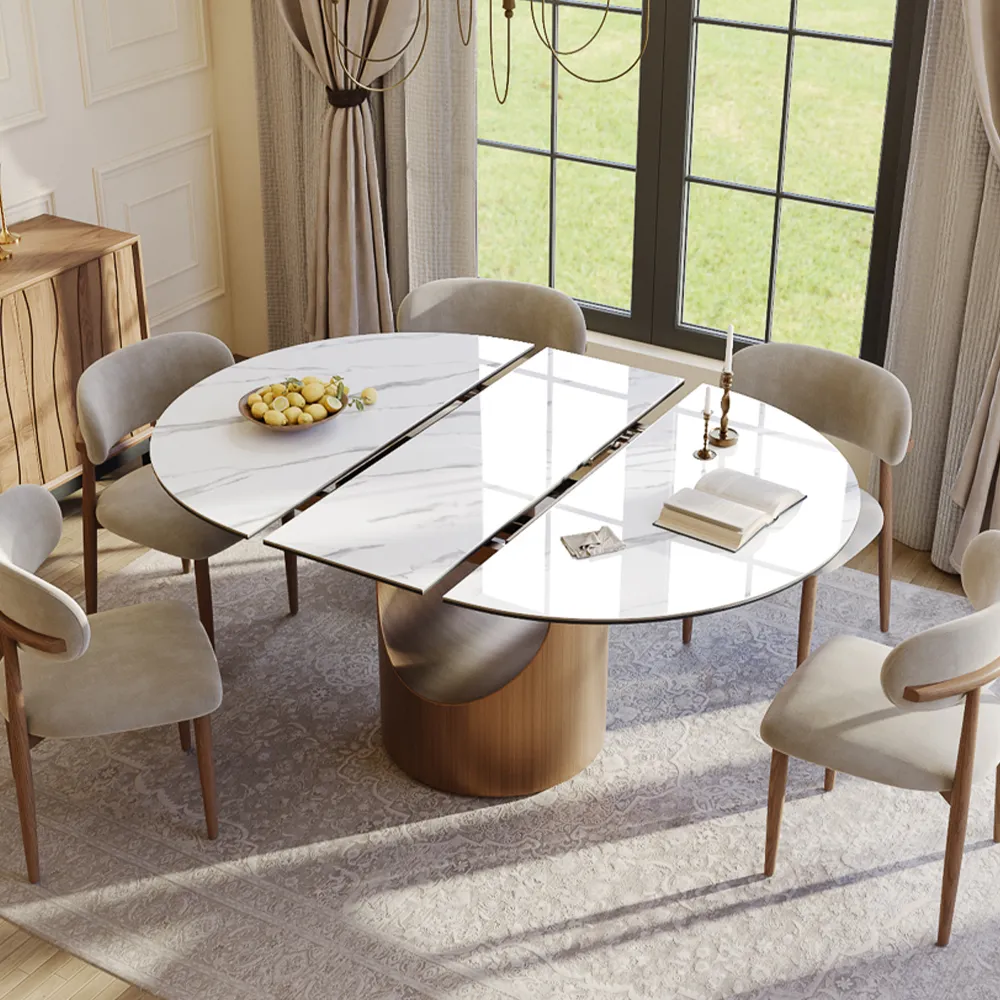
Once the floor test works, compare your taped outline with the exact dimensions of the table you are considering. The Hector-Oval Glossy Extendable Dining Table measures 47.24″ × 47.24″ when closed and 62.99″ × 47.24″ when extended. That closed-to-open range works well for households that want the room to stay open for weekday meals, then need two extra places for an occasional six-person dinner.
The final test is simple: after six chairs are pulled out, people should still be able to pass comfortably without brushing past a seated guest.
Seating Four Daily and Six for Guests
A product-page seat count shows how many chairs can fit around a table, but it does not always show how comfortable the meal will feel. For a round-to-oval design, treat four seats as the everyday setup and six seats as the hosting setup. This approach keeps weekday meals comfortable while giving you a practical option for summer dinners, birthday brunches, and family visits.
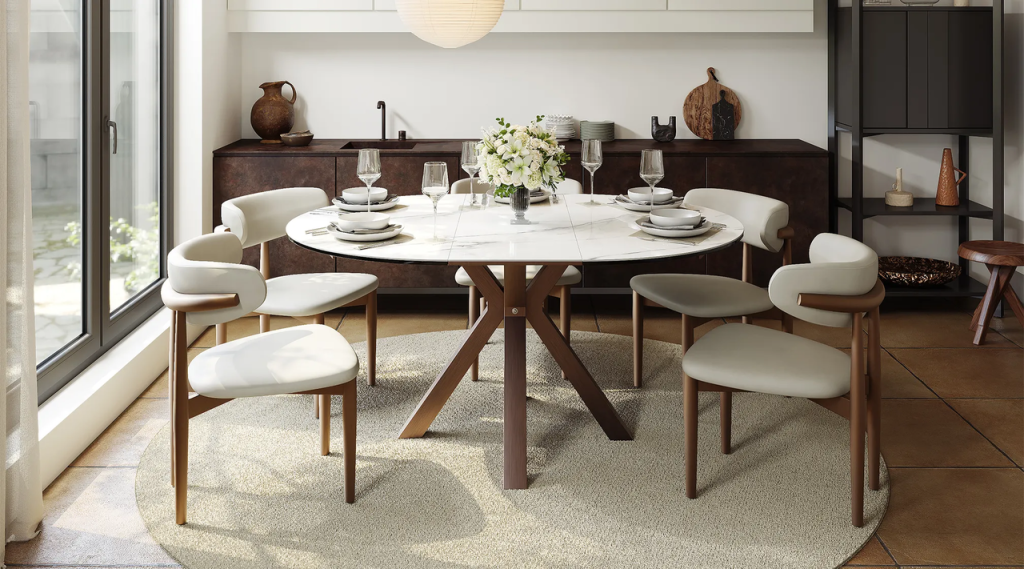
In its closed position, a 47-inch round table is usually most comfortable for four people. Each diner has room for a full place setting, a drink, and a few shared dishes without crowding the center. The round shape also supports easier conversation because every seat faces the table’s middle rather than placing two guests at distant ends. For daily use, keep the tabletop simple with a low centerpiece or a fruit bowl that can be moved aside when needed.
When the table opens into an oval, the added length creates space for two more guests at the ends. This works well for an occasional six-person meal with a relaxed place setting and a few shared dishes at the center. It is less comfortable for six people who use oversized chargers, several wine glasses, and individual serving dishes at every setting. When six people eat together several nights a week, a larger fixed round, oval, or rectangular dining table is the better long-term choice.
Chair dimensions determine whether the six-seat layout feels welcoming or cramped:
- Choose armless side chairs when possible; they are easier to position along the curved edge.
- Aim for chairs about 20 to 22 inches wide rather than deep armchairs that take up extra elbow room.
- Check the pull-back depth of each chair before finalizing the layout.
- Use the two most compact chairs at the oval ends, where clearance is usually tighter.
The goal is not simply to place six chairs around the table. Each guest should be able to sit down, stand up, and stay for dessert without turning the dining area into a crowded passageway.
Features That Make an Extendable Table Easier to Live With
Once the floor plan and seating layout work, focus on the details that determine whether you will actually use the extension feature. A round extendable dining table should open smoothly, stay stable when extended, and handle everyday meals without creating extra work. Finish matters, but the mechanism, base, and tabletop material have a greater effect on how the table feels after the first few weeks.
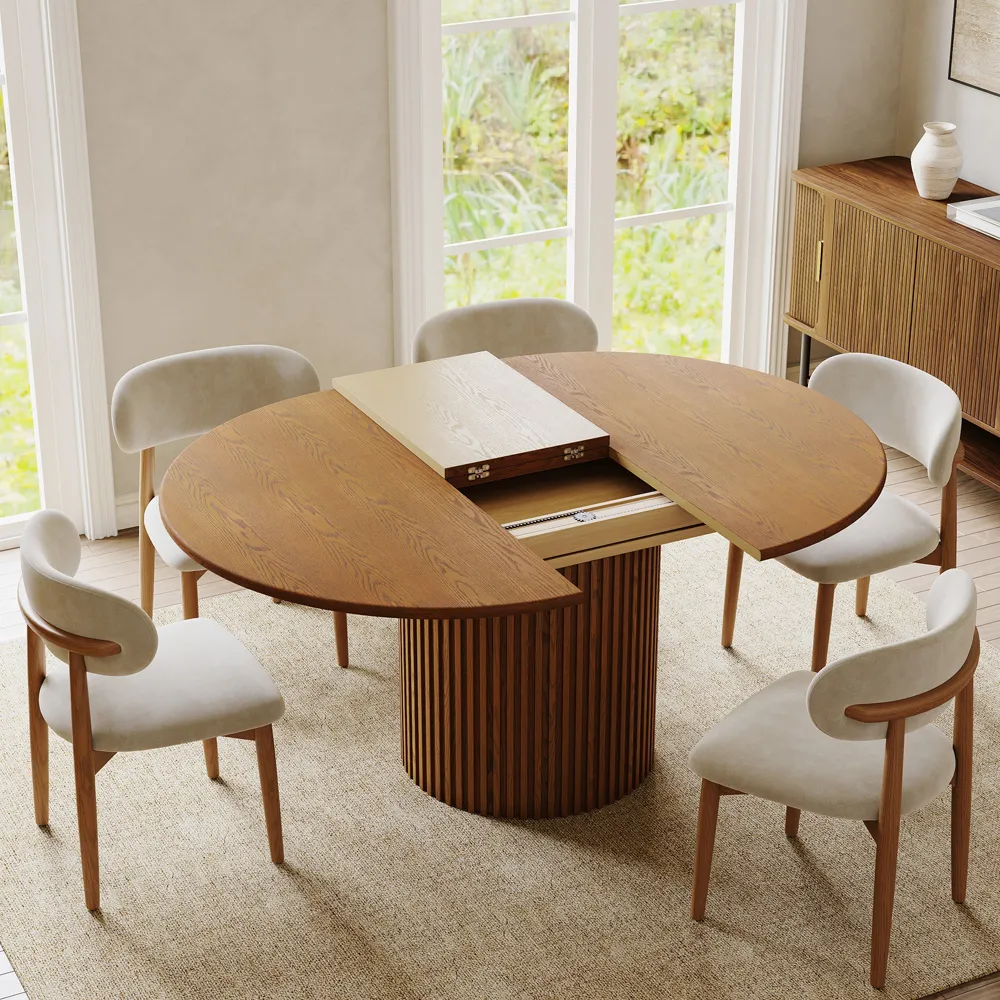
Start with the extension system. A self-storing leaf is usually the easiest option for households that host often because the leaf remains inside the table when it is not needed. A separate insert can work well for occasional gatherings, but only when there is a clean, dry place to store it flat. In either case, the table should be easy for one person to open without lifting a heavy panel or moving every chair out of the way.
The base matters just as much. A pedestal or open central base gives guests more flexibility around the curved edge and makes the two end seats easier to use. Four-leg tables can still be stable and attractive, but check where the legs sit after the table opens. A leg that lands close to an end seat can make the sixth place feel awkward, even when the tabletop is large enough.
For summer meals, choose a surface that suits the way your household eats. Cold drinks, berry desserts, grilled food, and hot serving dishes all put pressure on a dining table. Sintered stone is a practical option for strong resistance to heat, stains, and scratches. Wood brings warmth and natural character, but it needs faster spill cleanup and dependable trivets. Whichever material you choose, follow the care instructions and avoid abrasive pads or harsh cleaners around extension seams.
A table becomes genuinely useful when opening it feels as easy as setting out two more plates.
Creating a Comfortable Summer Hosting Flow
An extended table should create more seats, not more work. During summer dinners, guests often move between the kitchen, dining area, and patio with drinks, grilled food, or dessert plates in hand. The easiest way to host six people in a smaller dining area is to give the room three clear jobs: eating at the table, serving food nearby, and moving comfortably through the space.
Keep the dining table focused on the meal. Set each place with dinnerware, water, and only a few shareable dishes at the center. Move large platters, ice buckets, extra glassware, and dessert plates to a sideboard, kitchen island, or console. This gives each guest more elbow room and keeps the open oval surface from feeling crowded.
Use the surrounding furniture to support the gathering:
- Keep cold drinks near the kitchen or patio so guests can refill without reaching across seated diners.
- Place hot dishes on a protected serving surface instead of bringing every platter to the table.
- Use a low centerpiece that allows guests to see one another across the oval tabletop.
- Bring out the fifth and sixth chairs only after the table is extended and the serving zone is ready.
- Clear weekday clutter, such as mail, chargers, and work materials, before setting the table.
A round extendable dining table for small spaces works best when the rest of the room adapts with it. For a midsummer brunch, linen napkins and a low bowl of peaches can be set out the night before, while drinks and serving dishes stay off the table until guests arrive. The table expands for the meal, but the room still feels calm enough for people to linger after it ends.
Final Checks Before Ordering
Make the final decision based on the fully extended oval position, not the closed round one. A table should support daily meals, summer hosting, and normal movement through the room without forcing everyone to work around it.
Before ordering, confirm that your taped floor plan matches the product specifications:
- The open table leaves enough room for all six chairs to pull back.
- Doors, drawers, cabinets, and patio access remain usable when the table is extended.
- The table dimensions match the model you selected, including any removable leaf.
- The package can fit through your entryway, elevator, hallway, or stairwell.
- Delivery, assembly, placement, and return policies work for your home and schedule.
If the extended oval blocks a kitchen drawer, narrows the main route, or requires you to move furniture every time guests visit, choose a smaller model or a different table shape. The right table should make weekday meals easy and summer gatherings feel effortless.
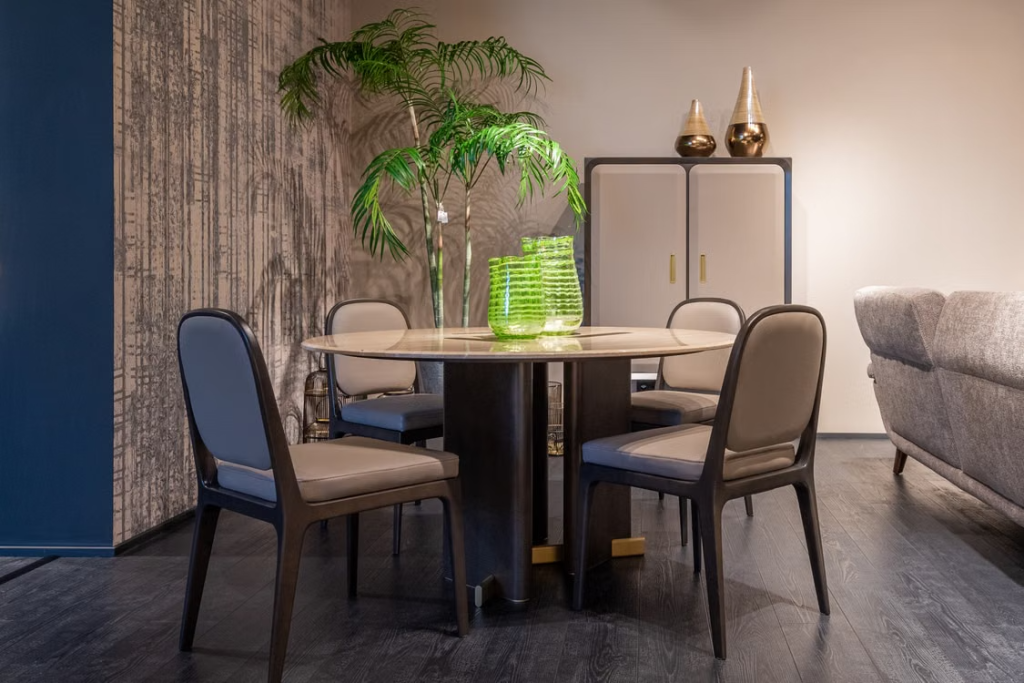
Conclusion
A round extendable dining table is the right choice when your home needs two honest versions of the same room: a comfortable place for everyday meals and an inviting place for summer guests. Measure the closed circle and the open oval, then test chairs and walking paths before buying. Plan for four seats in daily mode and six only when the extended shape leaves real clearance. When the layout works in both positions, the table does more than save space. It gives your home room to live, gather, and linger.
FAQs
What Rug Size Works Under a Round Extendable Dining Table?
Choose the rug for the fully open table, not the closed round size. Add at least 24 inches beyond every table edge, and aim for 30 inches when the room allows. Chairs should remain on the rug after they are pulled out, or the dining setup can feel unstable and cramped.
Can a Round Extendable Dining Table Work With a Banquette?
It can, but freestanding chairs usually provide more flexibility when the table opens into an oval. A banquette works best along one long side of the extended table, leaving enough room for end seating and chair pull-back on the opposite side. Measure the open position before committing to a fixed bench.
What Lighting Works Over a Round-to-Oval Dining Table?
A centered pendant works best when the table stays in one location in both positions. Choose a fixture that provides broad, even light rather than a narrow spotlight. A dimmable pendant or chandelier is especially useful because it can feel bright enough for weekday meals and softer for summer dinners.
Can a Round Extendable Dining Table Double as a Work Surface?
Yes, especially in smaller homes where the dining area also supports homework, laptop use, or casual projects. Keep a compact tray or basket nearby for chargers and papers. Before guests arrive, clear the work items so the table can shift back into a comfortable dining setting.


[…] Check the closed and expanded footprints of round extendable dining tables. […]
[…] clear a tabletop before using it, the problem may be the furniture setup rather than the styling. A round extendable dining table can be useful when one table needs to stay compact for everyday use but provide more usable surface […]