 By Charles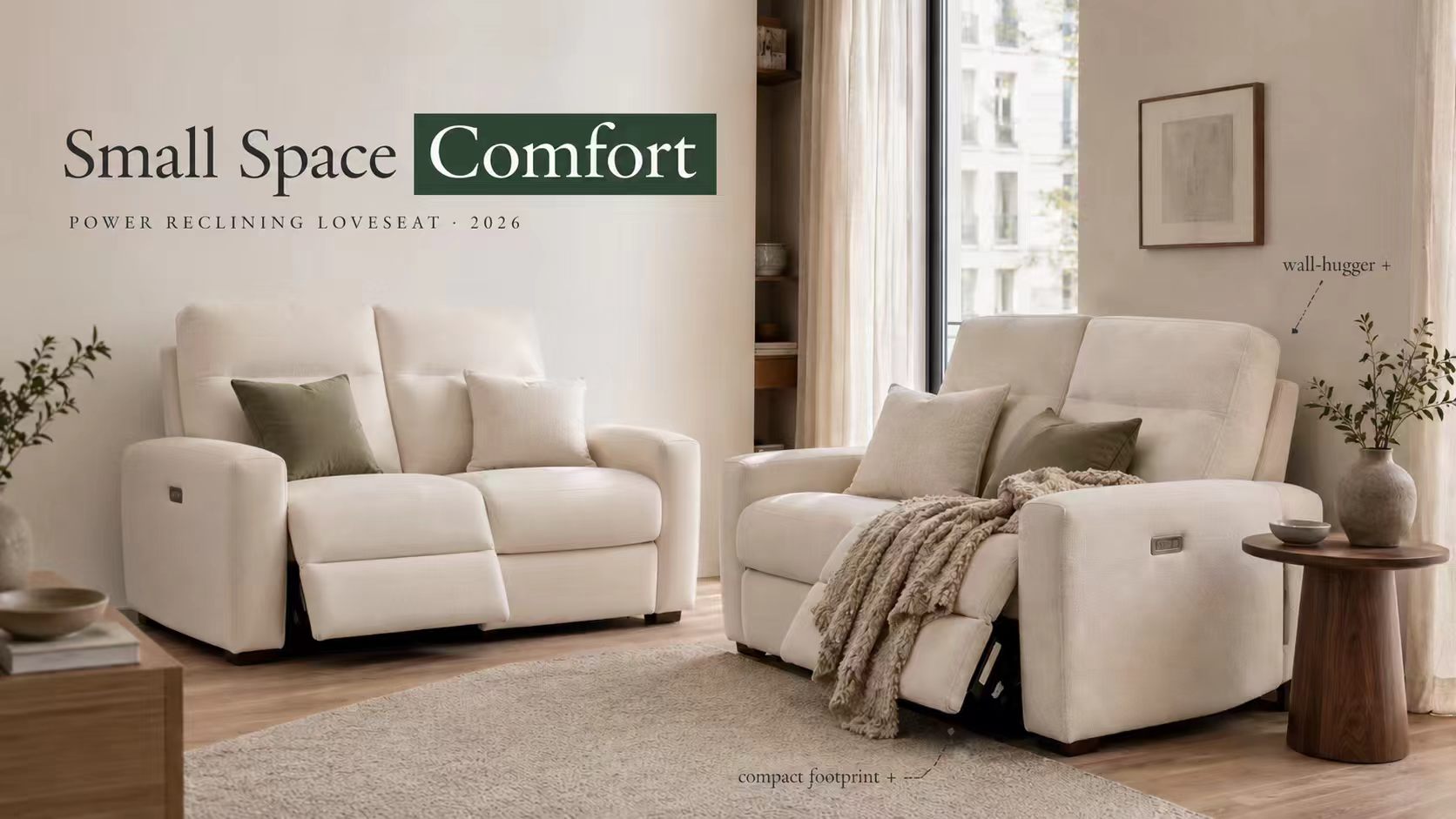
My partner reads to fall asleep. I watch hockey to fall asleep. For three years we tried to share a regular sofa for the hour before bed, and one of us always ended up annoyed — either I was on my phone too loud, or her book light was angled directly at my face. The first weekend after we swapped that sofa for a power reclining loveseat, she leaned back at 75 degrees with her reading lamp on, I sat upright at 95 with the laptop, and neither of us said a word for an hour. That’s the case for this category in one paragraph.
A power recliner loveseat is a niche piece pretending to be a mainstream one. It works beautifully when the room is small, the user count is two, and the daily routine rewards independent positioning. It’s wrong for almost everyone else.
What a Power Reclining Loveseat Solves
A power recline loveseat earns its place when you’re solving three frictions at once: not enough wall length for a full sofa, two adults with different evening postures, and a small living room where every piece has to multi-task.
The width math is the first filter. A standard sofa runs 60 to 96 inches wide, while Dimensions’ reference data on loveseats puts the loveseat range at 48 to 72 inches. If your primary wall is 9 to 11 feet long, a full sofa eats the entire wall. A loveseat at 60 to 68 inches leaves room for a side table and floor lamp — which is what makes the rest of the room function.
I’d skip a loveseat power recliner entirely if any of these apply:
- You live alone and prefer a single recliner chair. You’ll save money and floor space.
- Your wall length is over 12 feet and you’d rather have a full sofa seating three.
- You need overnight sleeper capacity. Reclined loveseats are not sleep surfaces — seat depth tops out around 22 to 24 inches, fine for a nap but rough on a real night of sleep.
- One of you is over 6’2″. Loveseats with a center console can be narrow per seat for taller adults — measure individual seat width before ordering.
Best Rooms and Users for This Seating Type
Couples and Shared TV Spaces
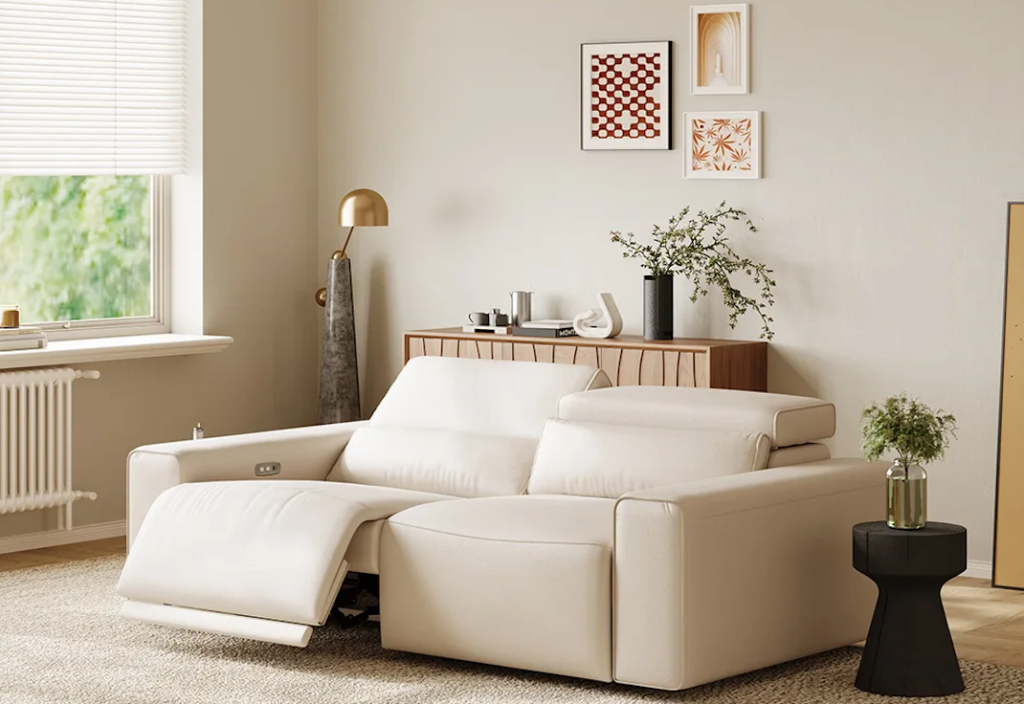
This is the bullseye use case. Two adults, one main viewing surface, evening routines that don’t perfectly overlap. Dual-motor designs let the headrest and footrest operate independently on each seat — one person can sit upright with feet flat while the other reclines to 135 degrees, and neither motion affects the other’s position. That sounds like a small thing on a spec sheet. It’s the difference between fighting over the sofa and ignoring each other peacefully — which in a long relationship is the same thing as harmony.
The detail couples underrate: hand control placement. Each seat has its own controller, so you adjust your own angle without leaning across the other person. Test it on day one — if the control feels awkward in your dominant hand, you’ll never use the full range, and a $2,000 mechanism becomes a $400 fixed loveseat.
Small Living Rooms That Need Reclining Comfort
A small living room is anything under about 14 feet on the long wall. In that footprint, every furniture decision is a trade-off, and a power reclining loveseat with console or no-console competes against a regular sofa plus a single recliner — which often wins on flexibility but loses on coordination, because the recliner never matches the sofa fabric and the room ends up looking patched together.
Tape it out before you commit. Painter’s tape on the floor marks the closed footprint (typically 60 to 70 inches wide by 38 to 42 inches deep), then add 30 to 36 inches to the depth for the extended footrest zone. If the combined footprint leaves at least 36 inches of walkway between the loveseat and the TV wall, you’re fine. Under 30 inches and the room will feel cramped within a week. POVISON’s loveseat collection lets you filter by width, depth, and assembly type before you commit to a footprint.
Visual weight matters as much as physical footprint. Three details reduce visual mass in a small room: lighter upholstery color, exposed legs (4 to 6 inches of leg height keeps floor visible underneath), and a back height under 36 inches.
Console vs No-Console Power Loveseats
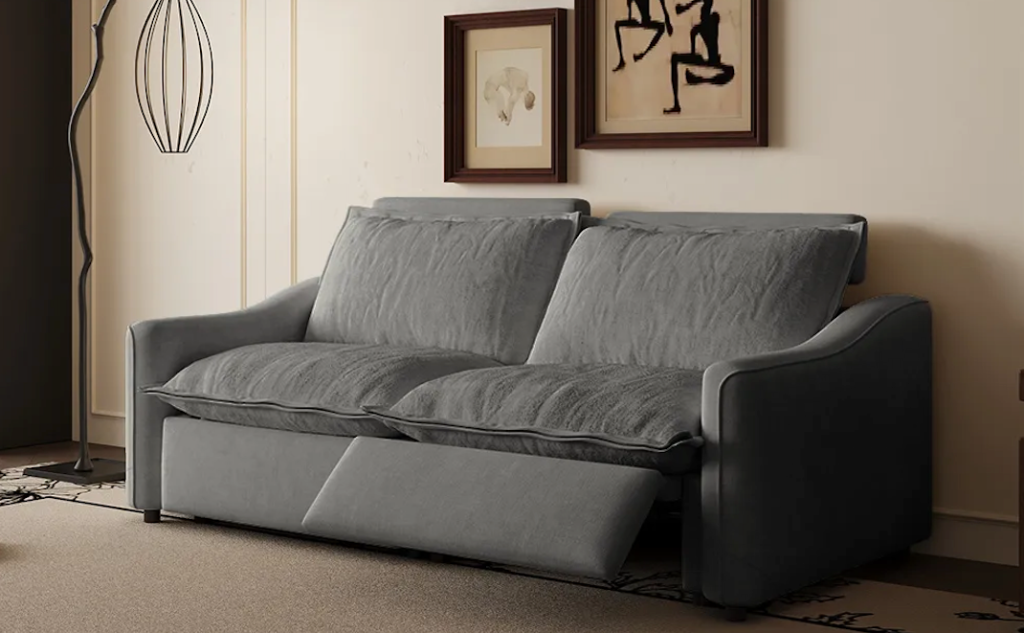
The center console is the biggest decision after width. A power reclining loveseat with console adds a fold-down or fixed middle module between the two seats, usually 8 to 10 inches wide, providing storage, cup holders, and increasingly USB-A and USB-C charging ports. Modern console designs also integrate the power module for the recline motors and any charging outlets, which is why the electrical baseline matters — motorized household furniture in the U.S. is evaluated against UL 962, the standard for household and commercial furnishings, covering wiring, electrical integration, and stability for products with built-in motors.
The console isn’t free, though. Here’s the trade-off:
| Feature | With console | Without console |
| Total width | +8 to 10 inches | More compact footprint |
| Per-seat usable width | Slightly narrower | Wider seat per person |
| Storage | Yes (drinks, remotes) | No |
| USB charging | Often built in | Sometimes armrest only |
| Shared-seat use | Blocked by center | Open across both seats |
| Visual mass | Heavier, “media room” | Lighter, “living room” |
The decision rule: if you and your partner sit independently more than you sit close together, a console pays for itself. If your evenings involve one person draped across the other or legs tucked over a lap, skip the console. It’s a behavior question, not a feature question.
Leather, Controls, Clearance, and Cleaning Checks
Leather. If you’re shopping a leather power reclining loveseat, the label matters more than the photo. The Federal Trade Commission’s Guides for Select Leather and Imitation Leather Products at 16 CFR Part 24 require honest composition disclosure — “top-grain leather” and “bonded leather containing 60% leather fibers and 40% non-leather substances” mean very different things. On a small-room loveseat where the upholstery is the visual focus, the wrong material choice is visible every time you walk in. Bonded leather peels at fold lines within two to four years of daily use; top-grain leather or quality performance microfiber leather lasts much longer.
Controls. Test the recline motion through its full range on day one. The motor should run smoothly without grinding, hesitation, or a hard stop that jolts the seat. Linear actuators at this price tier run at conversation-level volume — about the noise of a microwave on low.
Clearance. Standard reclining seats need 10 to 12 inches of wall clearance to fully open the back. Wall-hugger mechanisms drop that to 3 to 4 inches because the seat slides forward as the back tilts. For a small living room, that single feature can be the difference between the loveseat fitting and not fitting. POVISON’s reclining furniture collection covers both standard and wall-hugger options across single seats, loveseats, and full sofas, so you can compare clearance side by side.
Cleaning. Small spaces work against you here. The loveseat is the focal point, every spot shows, and the seam where the seat meets the footrest mechanism collects crumbs and pet hair faster than on a fixed sofa. Plan a weekly vacuum of the seams with a crevice tool, and pick upholstery you can spot-clean — top-grain leather wipes clean in seconds; untreated linen or cotton will show every coffee splash for years.
FAQ
Is the console in a power reclining loveseat actually useful in daily life?
Depends on how you watch TV. If you and your partner usually have a drink, the remote, and a phone within reach during a movie, the console pays for itself within a week — it consolidates the clutter that would otherwise live on a side table. If your evenings involve curling up together or stretching across both seats, the console blocks that posture and you’ll resent it. Choose by behavior, not by spec sheet.
How much do power reclining loveseats affect the overall look and feel of a small living room?
Less than people fear, more than the catalog photo suggests. A power reclining loveseat is visually heavier than a slim modern sofa because the mechanism adds back and seat depth — expect 38 to 42 inches of overall depth versus 30 to 34 for a fixed loveseat. The mass is manageable with the right styling: lighter upholstery color, exposed legs, and lower back height all reduce the bulky feel. A dark leather model with no visible legs and a 40-inch back dominates a small room. Same footprint in lighter performance fabric with 5-inch legs reads as a regular sofa.
Do couples usually find power reclining loveseats comfortable for both people at the same time?
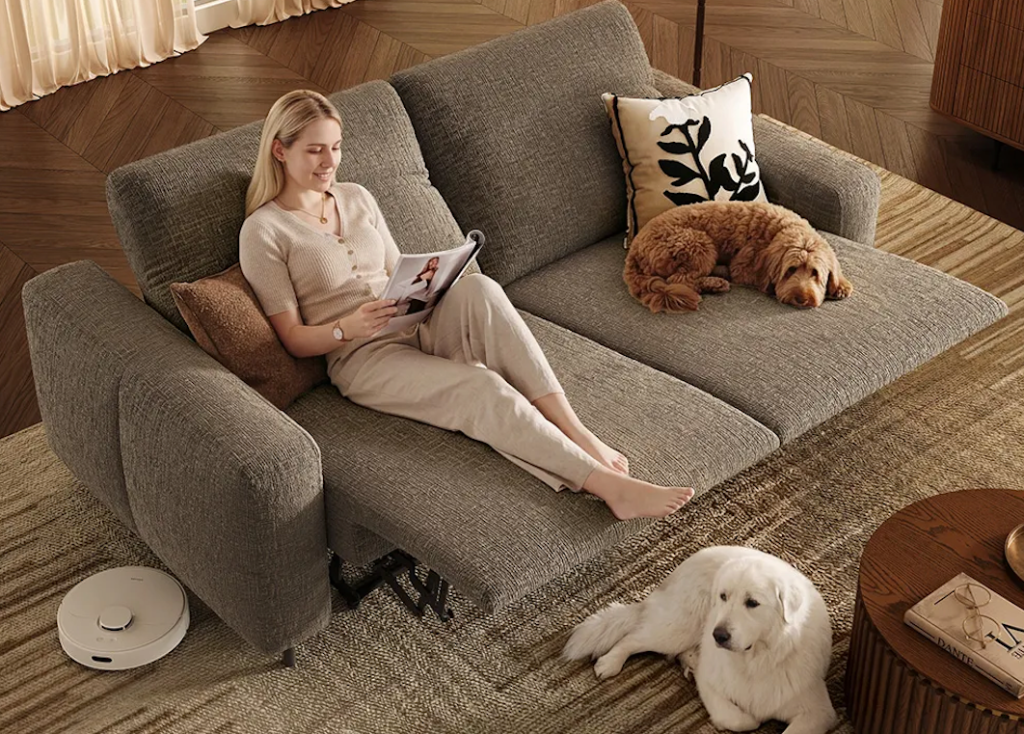
For most couples, yes — but the comfort depends on independent control. Dual-motor designs (separate motors for each seat) let each person dial their own angle without affecting the other. Single-motor designs link both seats to the same recline path, which is fine if both partners want the same position but frustrating if not. The other variable is shared seat width: with a center console, effective seat width drops to about 22 to 24 inches per person — comfortable for most adults, tight for anyone over 6’2″.
What happens to the space behind a power reclining loveseat when it is fully reclined?
Depends on the mechanism. A wall-hugger power reclining loveseat moves the entire seat forward on tracks as the back tilts, keeping the back just 3 to 4 inches from the wall through the full recline range. Standard pivot designs need 10 to 12 inches of clearance because the back rotates rearward as it tilts. For a small living room against a fixed wall — especially one with a window, thermostat, or outlet at low height — wall-hugger is usually worth the upgrade.
Are power reclining loveseats harder to keep clean than regular loveseats?
Slightly, in two ways. First, the seam between the seat cushion and the footrest mechanism collects crumbs, hair, and dust that a fixed loveseat doesn’t deal with — most owners run a vacuum crevice tool through the seams weekly. Second, the recline track underneath a power reclining loveseat isn’t always easy to access, so anything that falls behind the seat stays there until you tip the loveseat forward. Outside those two friction points, cleaning is the same as any upholstered loveseat — upholstery choice matters more than mechanism.
Conclusion
A power reclining loveseat is one of the most rewarding pieces you can put in a small living room — but only when there are two of you, the room is genuinely tight on wall length, and the daily routine rewards independent positioning. Tape the closed and extended footprint before you buy, decide the console question by your behavior rather than the spec sheet, and read the leather label before you read the price. If the math works, a good loveseat will quietly upgrade a hundred ordinary evenings a year. If any check fails, save your money and buy a great fixed loveseat instead.
Related Reading:


